Multiomics Bioinformatics Career: Dr. Efstathios Vlachavas's story
Dr. Efstathios Vlachavas joined Genevia Technologies as a senior bioinformatician after a research career spanning translational oncology and multi-omics research across three countries. Two years in, he's worked on client projects across a wide range of research areas and data types, and he's found that this variety is exactly what keeps the work exciting.
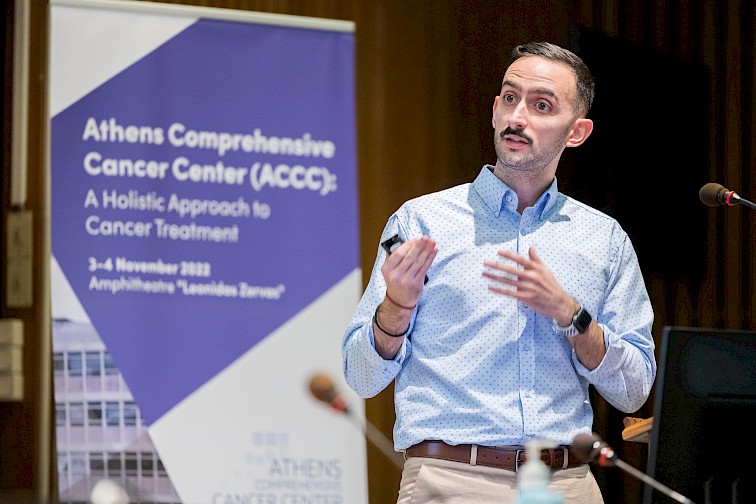 Dr. Efstathios Vlachavas
A specialty built on layers of data
Efstathios's path to bioinformatics started with a Bachelor's degree in molecular biology and genetics, and a Master's in clinical pharmacology, both in Greece. He went on to a PhD in translational oncology, funded by a highly competitive scholarship, which introduced him to microarrays and then RNA-seq. During his PhD, a Marie Curie fellowship took him to Rennes, France, for a research stint studying a stress-response protein in glioblastoma. His drive for the field has a personal root: he lost his mother to cancer, after a long illness, during those years. "That made the work personal for me," he says, "not just to do research, but to see if it could actually help people. I'd like to say that's what paved my way to bioinformatics."
A postdoc at the German Cancer Research Center (DKFZ) in Heidelberg, Germany, shifted his focus to whole-genome sequencing and mutational data, the primary data type behind molecular tumor board decisions, where he helped develop a scoring method for prioritizing actionable mutations with Johns Hopkins. From there, his expertise extended into mass spectrometry-based proteomics methods. "My specialty ended up spanning all of these layers," he says, and it's a range that still shapes how he thinks about precision oncology today.
Mutations, in particular, remain central to his view of the field, although he's equally drawn to proteomics as the layer that ties everything together. "Even with the sheer volume of information we have today, mutations still play a pivotal role in whether a patient gets a specific treatment or not." As for proteomics: "It's like a blueprint of the cell," he explains. "If you don't see a signal at the protein level, most of the time it means nothing is actually happening, no matter what the mutation or gene expression data suggests."
That conviction is also why he's watching the shift toward multi-omics integration closely, particularly intrigued by the efforts to combine imaging data with single-cell and spatial technologies. "The single-cell tsunami era has already happened. Now we're in the spatial era, and it's not even emerging anymore. It's established."
Looking further ahead, he sees the next decade defined less by generating more data and more by translating it into the clinic. "Despite all the fancy technologies, hospitals and tumor boards still struggle to take this information and make it usable at the bedside. That translation gap, helped along by things like liquid biopsies and circulating free DNA for earlier diagnosis, is where I think the real fight is."
He's watching the growing hype around virtual cells and generative AI models with a healthy dose of caution, too. "One thing worth saying plainly, despite all the current AI momentum: the fundamentals like sound statistics, causal reasoning, rigorous data analysis, still remain the non-negotiable foundation for deriving anything functionally meaningful from these models. No amount of "machines that think" replaces that groundwork," he notes.
Two years of variety
Looking back on his time at Genevia so far, Efstathios describes the diversity of projects as one of the most rewarding parts of the job. "I came in as a cancer expert, but I ended up working on pulmonary, cardiometabolic disease, even GWAS studies. It's nice not to just lean on your existing expertise, but to be pushed to interact with things outside your comfort zone."
He also points to a difference in mindset compared to his research background: "In academia you can build collaborations, but there's always an underlying competitiveness. What I like about Genevia is that it feels more like a unified goal: Genevia's success is your success. Even when you're working on something individually, it always feeds into something bigger, and that has more meaning for me."
Among his favorite client projects, Efstathios highlights his ongoing collaboration with physician-scientist Dr. Michaela Lucas, whose research group focuses on transplantation immunology and drug allergy research; Dr. Lucas also serves as principal investigator for the PERTH Trial. "It's been a genuinely rewarding collaboration since early this year," he says. "Working at the intersection of immunology and clinical trial data is a different kind of challenge, and it's pushed me into territory outside my original cancer focus."
He also points to a biomarker discovery project for liver cancer, with a biotech company focused on precision medicine and diagnostics. He describes it as one of the more scientifically demanding engagements he's taken on, requiring close, iterative work with the client's own data and assumptions.
A key lesson from his postdoc guides how he approaches client projects today: "It's essential to bridge the gap between wet and dry lab, and to ask as many questions as possible at the start. That's the most solid foundation for any project, whether it's a client, a collaborator, or a grant partner."
When asked what skills matter most in his current role, Efstathios doesn't point to any single programming language or tool. "Regardless of how many languages you know, the most important thing is asking the right question and finding the right tool for the right task." He's candid that this increasingly includes prompt engineering: knowing how to search efficiently and delegate work to the right resource, rather than reinventing the wheel under time and result pressure.
Just as important to him is science communication and efficient data story telling. "You can have someone who's done incredibly sophisticated analysis with amazing results, but if they can't communicate even half of the meaning behind it to an audience, that work loses most of its value."
Underpinning both is a habit of continuous self-study that he's maintained since he first moved from wet-lab work into bioinformatics: working through online courses, following conference talks, and setting aside dedicated time each week to stay on top of new methods. "No one can know every tool or every method. But if you stay on track and can communicate what you know, you're in a good place."
Life at Genevia, and outside it
Working remotely was, in Efstathios's words, "the ultimate dream," a chance to stay close to family after years split across countries during his research career. He pushes back gently on the assumption that remote work is less productive, although he acknowledges that maintaining the mental drive to stay efficient and undisrupted in a home office can sometimes be a challenge. He's a fan of Genevia's in-person get-togethers too, for the chance to catch up face-to-face.
For Efstathios, recharging and finding inspiration for new ideas comes down to protecting time for the things outside work: friends, family, and, several times a week, martial arts, as well as occasional video games. "Martial arts are important for self-discipline, but also for being part of a group and learning to collaborate." In addition, he's a longtime dog lover who, a few years ago, unexpectedly adopted a stray cat, Lucy. "It's been a completely different, and pretty funny, process compared to dogs."
Underneath all of this is a simpler principle he keeps coming back to: mental health comes first. Having navigated the pressures of a PhD and postdoc, Efstathios treats coping with stress as a daily priority rather than an afterthought. "It's really important to maintain mental health at any cost, so that you're able to be productive in your work," he says.
Contact us
Leave your email address here with a brief description of your needs, and we will contact you to get things moving forward!