Meet Dr. Georgios Fotakis, Senior Bioinformatician at Genevia
For Dr. Georgios Fotakis, the joy of science lies in tackling new challenges. That mindset has taken him from modeling tumor evolution during his PhD to analyzing spatial data and building AI infrastructure as a senior bioinformatician at Genevia, where no two days look quite the same.
Chasing scientific challenges
Georgios's interest in bioinformatics took shape early. As a biology undergraduate, he was already drawn to programming, algorithms and data structures, alongside a long-standing fondness for mathematics, modeling and statistics. "It came more as a natural evolution than something I set out to do," he says. Bioinformatics offered the combination of all those interests in a single field.
After his bachelor's degree in biology, Georgios completed a master's degree in bioinformatics in Athens and went on to earn his PhD in bioinformatics in Austria.
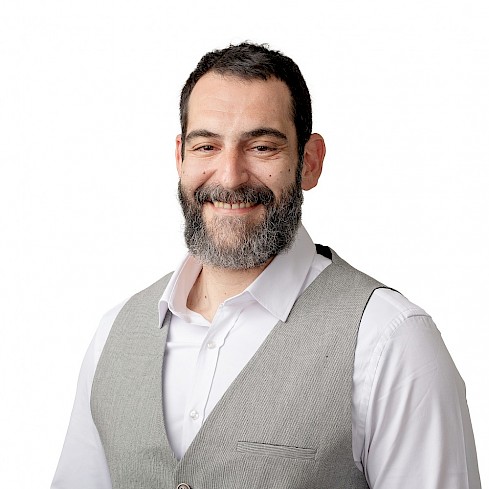 Dr. Georgios Fotakis
Georgios's research focused on immuno-oncology and tumor evolution. His PhD began on the theoretical end of the spectrum, using mathematical models to describe how tumors evolve and interact with the immune system. Over time, the project shifted toward more interpretable, biology-driven questions and came to include artificial intelligence, a change he welcomed.
What sparked his interest in cancer research was the intellectual puzzle. Cancer evolves rapidly and in ways that resist explanation by established evolutionary frameworks alone, which continues to fuel scientific and even philosophical debate. That challenge, and the question of how such a phenomenon can be modeled at all, is what kept him engaged.
Asked about the work he is proudest of from his academic years, Georgios points to the neoantigen prediction pipelines he developed, which are now widely used by the research community. Knowing that his algorithms help other scientists is, for him, the most satisfying outcome of those years.
The many sides of a senior bioinformatician's role
As Georgios began considering a move from academia to industry, he was looking for a role that would keep him close to scientific research while allowing him to return home to Athens. A friend and Genevia colleague told him about an open position, and after applying and going through the interview process, he joined the company in 2024.
Today, Georgios works as a senior bioinformatician, and his days rarely look the same. Data analysis is at the core of his work, primarily next-generation sequencing data spanning single-cell, bulk and spatial omics. Recent projects have increasingly involved spatial platforms such as Xenium and CosMx, and he also works on optimizing analysis workflows, particularly in Nextflow.
Beyond data analysis, Georgios supports and expands Genevia's IT infrastructure and has lately become deeply involved in the company's AI and machine learning operations. That technical side is a large part of what he enjoys. "Losing myself in the code is one of the best moments in my day," he admits.
Working fully remotely from Greece suits Georgios well. He values being able to set and follow his own schedule, and the Greek weather is a welcome bonus.
Data, deadlines and the craft of storytelling
In all his work, Georgios's central aim is helping researchers extract meaningful biological insights from increasingly complex, multimodal datasets. He has watched that complexity grow project by project in recent years, and he relishes it. "That's what science is all about, right? Challenges and overcoming them."
The demands of client projects also keep him current. Rather than racing to keep pace with the field, he sees staying informed as part of the job itself: answering each project's questions requires dedicated time for research, and the projects arriving at Genevia have been complex enough to keep him in close touch with the latest developments.
One development he is especially looking forward to is 10x Genomics' newest spatial platform, Atera. Georgios is already contributing to panel and probe design for an upcoming Genevia project using the technology, expected to start in the new year. Analysis tools for the platform are still maturing, so the project will also involve some groundwork: understanding the data structure and how to handle it.
For Georgios, the most important skill in bioinformatics goes beyond analysis. "It's not only how well you are able to analyze your data, but also how well you are able to present and communicate it," he says. "For me it's not only creating the story, but also telling the story."
Communicating science was already central to his academic work, given how often bioinformaticians collaborate with physicians, statisticians, mathematicians and programmers. What changed in a service setting is the emphasis on managing expectations: explaining the complexity of a requested analysis, fitting it into a defined timeline and deadlines, and structuring results in a clear, straightforward way. Time management, he says, has become one of the biggest parts of the job.
Driven by curiosity
Outside work, Georgios's reading still gravitates toward science, especially artificial intelligence. He is particularly interested in how AI's scientific progress intertwines with its financial and commercial sides, and in its broader consequences for society and the environment, including the substantial environmental footprint of the data centers that power AI models.
That wide-ranging curiosity is the same one that once drew him to biology, programming, mathematics and statistics, and to the field that brought them all together. For those considering the same path, Georgios's advice is honest: bioinformatics takes patience, hard work, a great deal of time and an open mind. It is a competitive field, and contributions often go unrecognized by the many disciplines bioinformaticians work alongside. That is why genuine passion matters most. "You should really love the field and your work. If you do, the rest will be a lot easier."
And if he weren't a bioinformatician? His answer comes without hesitation: physics.
Contact us
Leave your email address here with a brief description of your needs, and we will contact you to get things moving forward!