Building a Long-Read Sequencing Pipeline for Individual (Epi)genomics
Collaboration with Genevia Technologies helped a research team at Maastricht University Medical Center strengthen a nanopore data analysis workflow for repetitive genomic regions. The collaboration resulted in the publication of a user-friendly, open-source pipeline. Dr. Leena Putzeys reflects on how Genevia’s expertise helped bring this tool to the wider scientific community.
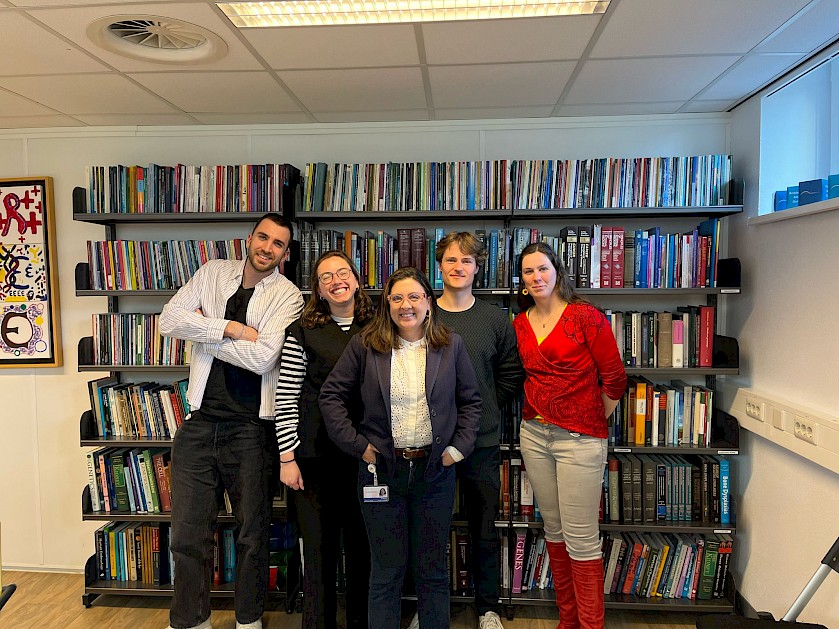
Core team from the UNIQUE lab behind the ECHO pipeline. From left to right: Brando Poggiali, Leena Putzeys, Athina Vidaki, Leonard Tiling, and Thessa Kroes.
A need for technical review and strategic guidance
The UNIQUE research group, led by Dr. Athina Vidaki, at Maastricht University Medical Center focuses on individual and forensic (epi)genomics, with increasing attention to repetitive regions of human DNA, which remain difficult to analyze using conventional approaches.
The team, including Leena Putzeys and Brando Poggiali, needed a robust and reproducible pipeline capable of handling raw nanopore sequencing data from start to finish, producing biologically meaningful outputs including both sequence variation and DNA methylation analysis across repetitive genomic regions. Like many emerging genomics teams, they were balancing ambitious computational goals within a small research team, requiring additional project-specific expertise.
Rather than building the entire computational framework alone, the group chose to collaborate with Genevia Technologies to review and strengthen their evolving workflow.
The project began with a structured assessment of the existing pipeline. Genevia’s bioinformaticians, Dr. Nicole Flack and Dr. Henry Barton, reviewed the overall architecture, identified technical risks, and produced a written report prioritizing areas for improvement.
According to Dr. Putzeys, this first phase became an important decision-making tool for the research team.
“The report was a massive help for us as a first step in understanding where we can improve, what is suitable for us to do, and what should be prioritized first,” she says.
The review did more than identify technical issues: it helped the group determine where external expertise would create the greatest impact in the next phase of the work.
After the initial assessment, the collaboration moved into a detailed revision of selected scripts and workflow components.
Because the project involved both nanopore-specific bioinformatics and high-performance computing (HPC) environments, domain expertise was essential.
Dr. Putzeys notes that the scientific and technical fit was one of the strongest aspects of the collaboration:
“It would be difficult if a bioinformatician helping us had no clue about the challenges of nanopore sequencing. The background matched our needs very well.”
The combination of sequencing-specific expertise and HPC understanding allowed the team to refine practical implementation details that had previously been challenging to address internally.
Supporting a young research team entering advanced bioinformatics
For this group, outsourcing bioinformatics support was a new experience.
As a relatively new research team, they were still expanding their project-specific computational set-up and building bioinformatics experience. External support offered a practical way to move forward quickly while still learning the reasoning behind technical decisions.
That learning aspect became an important part of the project.
“It was important for us that we understood the thought process as well, so that we also learned along the way,” Dr. Putzeys highlights.
The short project timeline also added pressure, making availability an important selection criterion.
“We wanted to reach milestones fast, and it was very nice that Genevia could accommodate this within short timelines.”
Since both teams were actively working on the pipeline at the same time, communication needed to be direct and responsive.
Most discussions took place via email and GitHub, allowing scripts and changes to be reviewed continuously without interrupting ongoing development.
Direct contact with the scientists involved in the project also made the collaboration easier to navigate. Leena highlights that quick feedback was especially valuable:
“There was always a quick reply, and if any concerns or questions came up from either side, those were tackled smoothly.”
From pipeline review to scientific output
The workflow developed during the collaboration has already contributed to a scientific preprint published by the group, where Genevia Technologies is acknowledged for its role in supporting the computational work.
That progression, from pipeline review to manuscript preparation, reflects the long-term value of making data analysis workflows robust and open access early in a project.
Altogether, Vidaki’s team views the collaboration as successful and would consider working with Genevia Technologies again when future needs arise.
“We’ve had a positive first experience so far, so definitely if there is a need, we will contact Genevia again. I would definitely recommend Genevia,” Dr. Putzeys concludes.
Published research from this collaboration
- Poggiali, B. et al. (2026). ECHO: a nanopore sequencing-based workflow for (epi)genetic profiling of the human repeatome. bioRxiv 2026.03.18.712618; doi: https://doi.org/10.64898/2026.03.18.712618
Contact us
Leave us a message below if you would like to hear how we can help you.
